HomeSpeech and Language TherapySpeech Therapy Exercises for Children with Speech Disorders
Speech Therapy Exercises for Children with Speech Disorders
Written By: Michelle E. Sisto, MS CCC-SLP TSSLD S
According to the American Speech Language and Hearing Association, a speech sound disorder is difficulty with perception, motor production, or phonological representation of speech sounds. Speech sound disorders differ from language disorders, whereas language disorders are difficulties in the acquisition and/or use of language across modalities due to difficulties in comprehension and/or production of language.
Types of Speech Sound Disorders
Speech sound disorders can be either organic or functional, and speech therapy can help. Organic speech sound disorders are developmental or acquired, such as motor/neurological (apraxia/dysarthria), sensory/perceptual (hearing loss/impairment), and structural (cleft lip/palate). Functional speech sound disorders have no known cause and pertain to articulation and phonology difficulties.
Personalized Assessment and Targeting
Speech sound disorders may look different from person to person. There are several layers when thinking about this concept.
Assessing Skills for Speech Therapy Exercises for Children at Home
Discrimination: Where the person can listen and hear the difference between correct and incorrect production of sounds.
Isolation: Where the person can say the target sound by itself with no other sounds (/b/, /m/, /p/).
Syllables: Where the person can produce the sound with a vowel (ba, mo, pu).
Single words: Where the child produces the target sound in a variety of different positions (i.e. the initial, middle, and final). For example, a child may produce /b/ in the initial position, but have trouble producing the sound in the final position. The initial, middle, and final position of the word should be assessed separately and targeted as three individual skills.
Phrases/sentences: Where the child can produce the target sound in a sentence when surrounded by other sounds and words
Conversations: Where the child can engage in a full conversation while producing their target sounds
Planning Effective Speech Therapy Exercises for Kids at Home
Now that the targets have been selected (what sound and what skill level), where do you go next? You need to select target activities that allow for the child to practice their target word, repeatedly, with appropriate support and feedback to be successful. Speech sound practice usually consists of a lot of drill work because practicing sounds needs to have a high repetition to be articulated correctly. The most important thing to keep in mind is to keep the activities fun, engaging, interactive, and gamelike for optimal progress. Here are some sample exercises that can be implemented to target speech sound disorders.
Practical Speech Therapy Exercises for Kids
- Provide verbal cues, such as describing what the child’s tongue, lip, and mouth should do (i.e. “keep your tongue up and behind your teeth” for the /d/ sound). Provide visual cues, such as having the child observe your tongue, lips, and mouth movements during speech production. A mirror should be provided to allow the child to observe their own oral movements. Provide tactile cues, with either your hand, a lollipop, or a tongue depressor to touch the spot the child should place their tongue, move their lips, or produce the sound for direct support and understanding of where the sound should come from.
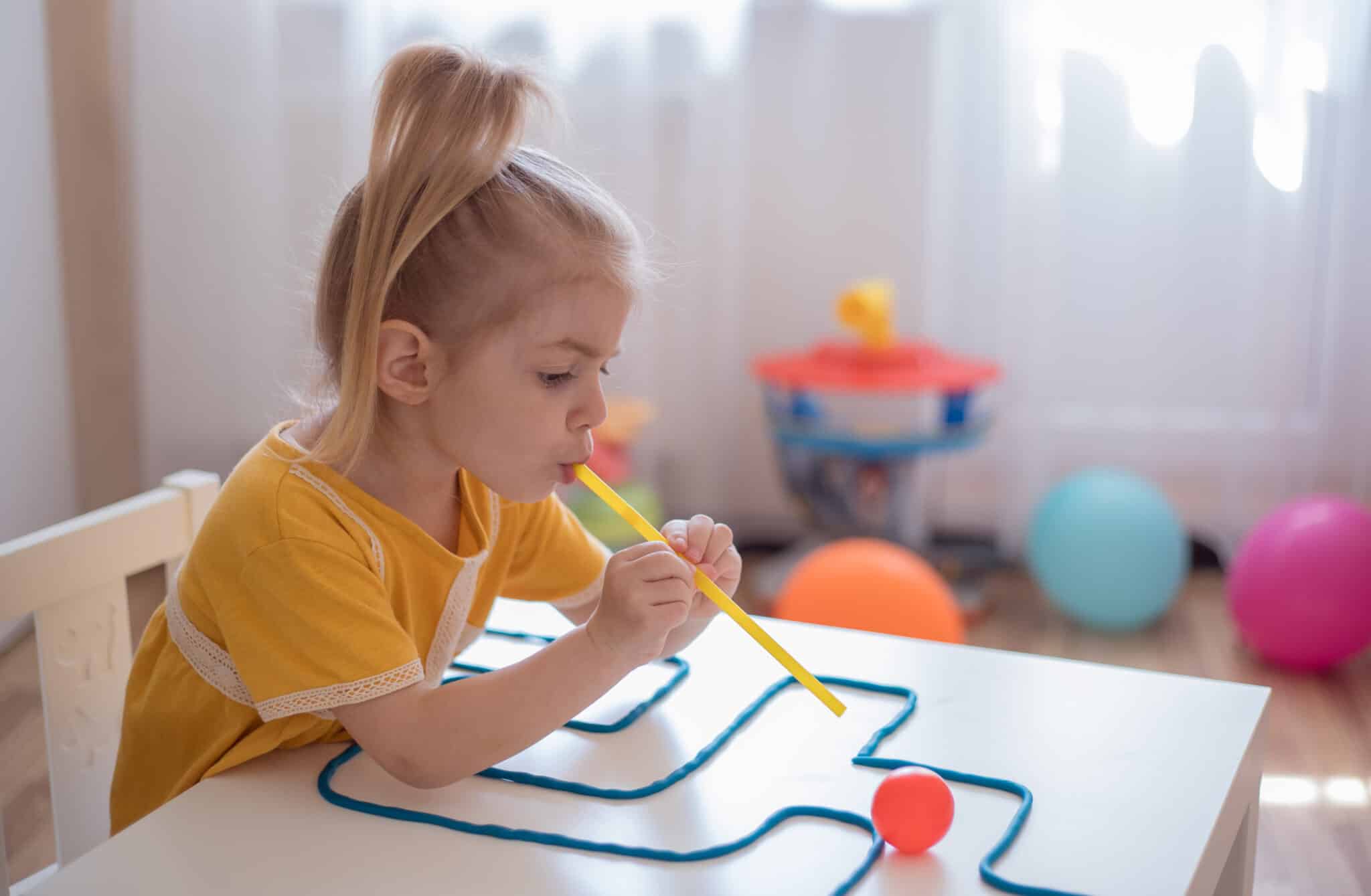
- For sounds, such as /f/, /v/, /s/, and /z/, that are produced by air escaping through a small passage in the mouth, give the child a straw and a cotton ball. Once they have appropriately placed their tongue and lips in the appropriate place, have them produce the target sound in isolation, while holding the straw to their mouth. If the child produces the sound correctly, the cotton ball should be blown across the table. Ensure that the sound they are producing is the target sound. This provides visual feedback for the child while they watch the cotton ball move.
- For sounds, such as /b/, /p/, /t/, /d/, and /w/, that are produced by bringing two lips together and air flow is interrupted and not steadily emitted, place a tissue in front of the child’s mouth. If the sound is produced the tissue should move and blow slightly before staying still. Take turns exaggerating the sound to have the tissue move, while producing the sound, to provide visual and auditory feedback.
- For sounds, such as /n/, /m/, and /ng/, that are produced with air being emitted from the nose, place the child’s hand underneath their nose. If the sound if produced correctly, they will feel the air blow against their hands, providing feedback for when the sound is being produced appropriately versus when there are misarticulations
Engaging Games for Speech Therapy at Home
Additionally, here are some fun games and activities to play with your little one to work on those sounds that are hard for them:
Feed the Stuffed Animals
Present the child with the stuffed animal and pictures of objects that begin with the target sounds. Before feeding the stuffed animal, model the target sounds and words for the child. Pause to allow processing and imitation time for the child to follow the model and produce the sound or word. After the child correctly produces the target sound and word, the child can feed the animal.
I-Spy
Present the child with picture cards of the target sounds and words being targeted. Describe one picture at a time, such as “I spy something yellow!”. The child will then be prompted to find the target picture and produce the sound and word being targeted. Verbal praise should be given to the child to encourage their continued progress and participation. Models of the target words and sounds should be provided to the child for them to imitate to produce the correct production.
Bingo
Print out bingo cards with pictures of objects that start with the targeted sound. Call out one picture at a time as a model. Following the model, pause to allow your child to imitate. Once they have imitated the target sound and word, give them play doh, coin, or dot marker to place over the word. Continue until all the words have been produced and they yell “bingo!”
Scavenger Hunt
Hide objects around the house that start with the target sound. Give the child a paper towel roll to use as a telescope and a basket. Have the child walk around the room, looking through the paper towel roll, to find the items. Once an object is found, ask the question “what did you find”. After the child labels the object, model the word back to them with the correct articulation. The child can put the item in the basket and move on to repeat the process with the other hidden objects.
Play Catch with a Beach Ball
Print out pictures of objects that start with the targeted sound. Tape the pictures onto each section of a beach ball. Throw the beach ball to the child. Whatever picture the child’s hand lands on is the picture they will label. Provide a model of the correct production of the target sounds and pause to allow them to imitate the model. Afterwards have the child throw the ball back to you and whatever picture your hand lands on is the one you say and model for them!
Speech sound disorder work is usually drill, drill, drill! This is because to learn how to produce sounds, practice makes progress. Just because it is drill work, doesn’t mean it needs to be a fight! Keep it light, simple, and fun! NO pressure, no frustration, just make memories and work on speech sounds at the same time.
Visit our NYC speech therapy and Virginia speech therapy pages.
Share this blog
Categories
Recent Blog Posts
-
 Connection Before Correction: The Neuroscience of Transformative Parenting
 -
 What is Pediatric Occupational Therapy? More Than Fine Motor Skills
 -
 What are the Benefits of Learning a Second Language as a Child?
 -
 Autism Acronyms and Terms Made Simple: A Parent’s Guide from Achieve Beyond
 -
Early Intervention Speech Therapy Evaluation: What to Expect and How to Prepare