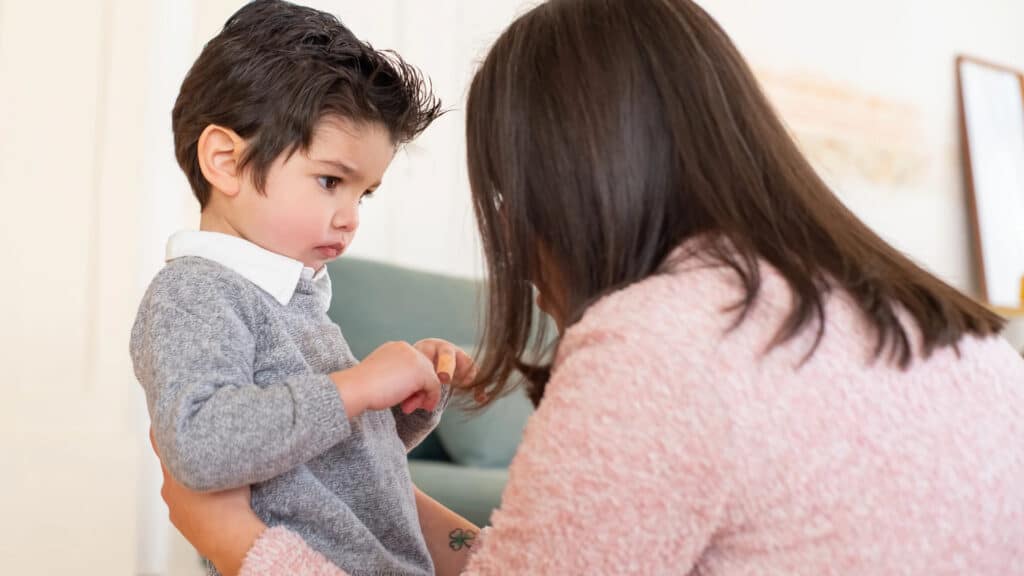
It’s a familiar scene: A great-aunt crouches with open arms and says, “Come give me a hug!” The child presses into a parent’s leg, hides their face, and goes quiet. Someone says, “She’s so shy,” and everyone waits. Parents often feel pulled two ways, wanting to respect their child and wanting to keep the peace with people they love. A slow to warm up child is not being rude, and the family is not doing anything wrong. So, how do we protect a child’s comfort level while still helping them join in?
How Slow-to-Warm-Up Children Respond to New Situations
Temperament is a child’s inborn style of responding to the world, and it shows up early. Researchers who study temperament in young children have described a group who approach new people, places, and foods cautiously, who pull back at first, and who then adjust gradually when the situation stays calm and familiar. This is a normal style and not a disorder or sole indicator of a bigger issue.
The pattern is easiest to recognize in motion. A two-year-old may spend the first thirty minutes of a family party on a parent’s lap, watching cousins build a block tower, and by dessert be directing the construction and laughing. A preschooler may refuse to say hello to a great-uncle and then, as coats go on at the end of the afternoon, bring him a favorite truck to look at. Each child is gathering information first, and participation follows.
Holidays stack the challenges. There are more people than usual, more noise, unfamiliar smells, and a schedule where naps and meals shift. Adults who rarely see the child want attention, hugs, and kisses all at once. For a child who needs time to take in new situations, that can mean too much input and too little control. A parent’s steady presence helps. Co-regulation, the way a calm adult helps a child settle, gives the child a secure base from which to look around, and a parent who stays relaxed and close tells the child the room is safe.
Preparing Children and Relatives Before the Visit
Preparation works best when it starts days ahead. Looking at photos of the relatives who will be there, makes faces familiar before they arrive. A parent can walk through the plan in simple words: “We are going to Grandma’s house. Eight people will be there, including Uncle Mike and baby Ellie. We will eat dinner, and then we will go home.” Naming a quiet spot, such as the guest bedroom with a few books, tells the child there is somewhere to go if the room becomes too much. Some families practice greetings at home so the child has options other than a hug, such as a wave, a high five, a fist bump, or a blown kiss.
Relatives are part of the plan, and a short message ahead of time often helps more than a conversation at the door. Parents can ask family to let the child approach in their own time, to get down to the child’s level instead of swooping in. Offering a toy, a job, or a side-by-side activity, such as setting out napkins or looking at a picture book together, tends to work better than questions like, “Aren’t you going to say hello?” Pressure for hugs and kisses is worth setting aside entirely. Children benefit from learning that they decide who touches their body, and a high five counts as a greeting.
On the day itself, small choices add up. Arriving early lets the child meet people one or two at a time and explore the house before it fills. A comfort object, a favorite snack, or headphones can stay within reach. A parent can stay close and describe what the child is doing without judgment: “You are watching first. That’s okay. Tell me when you want to join.” Give your child frequent choices (what toy to play with, where to sit, what to eat), so that they feel a little more in control.
Labels like shy can stick, so many clinicians suggest avoiding them in front of the child. If the child needs a break, taking one calmly and returning later shows that stepping away is a skill and not a failure. Leaving before the child is worn out lets the visit end well.
When Hesitation Calls for a Closer Look
Most slow to warm up children settle in with a familiar adult nearby, and they warm up faster each time they see the same people. Hesitation deserves a closer look when it looks different from this pattern. Examples include a child who stays distressed for hours despite a calm, close parent, who does not warm up to relatives seen many times over many months. A child who talks freely at home but consistently does not speak in certain settings, a child who has lost skills they once had, or a child who rarely responds to their name, uses few gestures, or shows limited interest in other people deserves attention beyond temperament.
Hesitation alone is not a sign of autism, anxiety, or a developmental delay, and many children with those profiles are not slow to warm up at all. What matters is the pattern across settings, how long it has lasted, and how much it limits the child’s daily life. A pediatrician is a good first call. For children under three, families can also contact the early intervention program, and for children three and older, the local school district. An evaluation can confirm that a child’s style falls within the typical range or point toward supports.
Temperament researchers use the term goodness of fit for how well a child’s style matches the demands of their environment, and children do best when adults adapt. A child who gets time and a calm adult does not need to be changed. This season, a quiet corner, a patient relative, and one parent who stays close may be the most useful things a child receives.
Achieve Beyond Pediatric Therapy and Autism Services supports families in understanding how young children respond to new people and places. If you have questions about your child’s development, we invite you to connect with our team.
 Tara is a Board Certified Behavior Analyst and Licensed Behavior Analyst (CT, MA, MD, TN, NY ) who has worked in the field of Applied Behavior Analysis and Special Education since 2009. She earned a Bachelor’s Degree in Sociology from SUNY Stony Brook, a Master’s degree in Childhood Education from Dowling College and completed her BCBA coursework at SUNY Stony Brook. Tara is a New York State certified teacher, holding multiple certificates in children with special needs.