A child has difficulty getting dressed and also struggles to climb stairs. A parent may hear two recommendations: occupational therapy and physical therapy. Because both can involve movement, play, and hands-on activities, it is easy to wonder where one ends and the other begins.
Pediatric occupational therapy and physical therapy have different areas of emphasis, but both are designed to help children participate more successfully in everyday life.
What Does Pediatric Occupational Therapy Address?
Occupational therapy focuses on the activities, or occupations, that are meaningful and necessary in daily life. For children, those occupations include play, learning, self-care, social participation, and routines at home and school.
A pediatric occupational therapist may work on fine motor skills, hand strength, visual-motor coordination, sensory processing, motor planning, dressing, feeding-related participation, handwriting, or other skills that affect independence.
The question is often: what does this child need or want to do, and which underlying skills are making that activity difficult?
A pediatric physical therapist may work with a child who has difficulty sitting, standing, walking, running, jumping, navigating stairs, maintaining balance, or participating in physical play. Treatment can also address movement patterns and help children use their bodies more efficiently and safely.
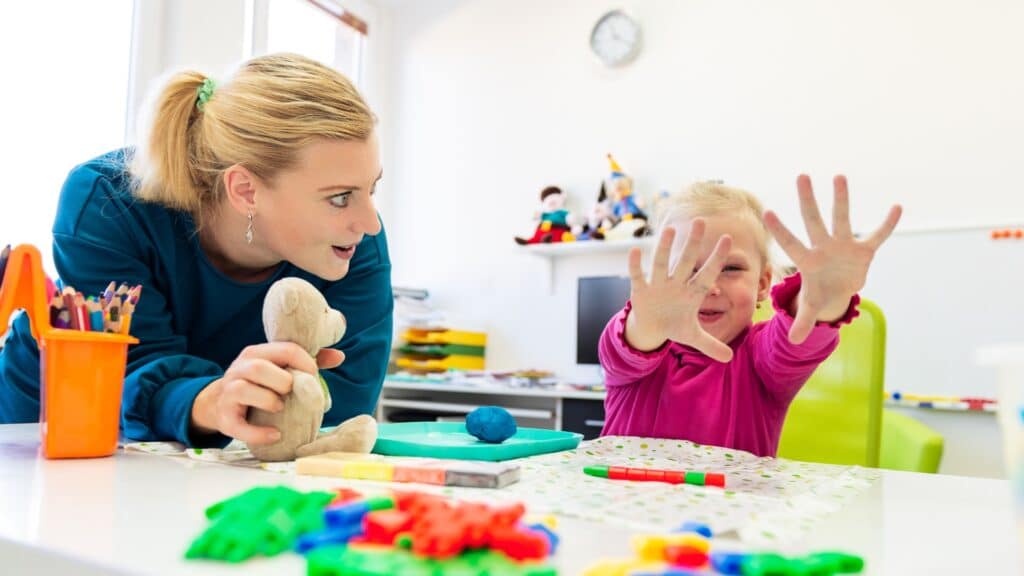
Both therapies often use play because play is how children learn and practice. An obstacle course could appear in either an OT or PT session, but the clinician may be using it for a different purpose.
A physical therapist might use the course to work on balance, lower-body strength, stair skills, or jumping. An occupational therapist might use a similar activity to address motor planning, sensory processing, sequencing, or coordination needed for everyday tasks.
Families may be referred to OT when a child has difficulty with fine motor tasks, self-care routines, sensory experiences, coordination, or participation in age-appropriate daily activities.
Examples can include trouble using utensils, managing fasteners, tolerating grooming, manipulating classroom materials, learning new movement sequences, or participating in routines because of sensory needs.
When a Child May Benefit From Physical Therapy
PT may be recommended when gross motor development, mobility, strength, balance, or physical access is the primary concern.
A child may need support learning to walk, keeping up on the playground, navigating stairs, recovering from an injury, improving balance, or developing movement skills affected by a medical or developmental condition.
Development does not divide neatly by professional discipline. A child may need the strength and balance to stand at a sink and the fine motor, sensory, and sequencing skills to complete handwashing. Another may need mobility to access the playground and motor planning to use unfamiliar equipment.
When both OT and PT are involved, collaboration helps connect the goals. Each clinician brings a different perspective to the child’s participation.
Parents do not need to diagnose which discipline is appropriate on their own. A pediatrician, evaluator, school team, early intervention program, or therapy professional may help identify which areas should be assessed.
An evaluation looks at the child’s current skills, everyday challenges, and functional needs. The recommendation may be OT, PT, another service, or a combination.
The Shared Goal: Participation
The simplest way to think about pediatric OT and PT is that both help children do more of what childhood requires. OT often focuses on the skills needed for everyday activities and independence. PT often focuses on the movement and mobility that allow a child to access those activities.
Achieve Beyond provides pediatric occupational and physical therapy services designed around each child’s individual developmental and functional needs.
 Achieve Beyond was established in 1995 and is a leading provider of pediatric therapy and educational services dedicated to helping children reach their full potential. Through a multidisciplinary team of experienced professionals, Achieve Beyond provides individualized services across Applied Behavior Analysis (ABA), speech and language therapy, occupational therapy, physical therapy, special education and other developmental areas.